The Tool Gallery
A comprehensive library of 80+ battle-tested frameworks for every stage of your consulting engagement.
Project Definition
A foundational scoping tool used to capture the project's core aim, current context, and desired outcomes. It serves as the primary data source for AI-powered strategic recommendations and pre-filling other frameworks.
Consulting ROI
A financial clarity framework designed to quantify the value of a consulting engagement. It helps consultants move beyond activity-based reporting to outcome-based value capture by measuring money saved or made.
First Principles
A mental model derived from physics that breaks complex business problems down into their most basic, non-reducible elements. Use this to bypass conventional wisdom and identify unique strategic levers.
SCQA Framer
A narrative-driven scoping tool (Situation, Complication, Question, Answer) used to align stakeholders on the problem definition. It ensures the proposed solution directly addresses the most critical strategic complication.
MECE Validator
A logic-checking methodology (Mutually Exclusive, Collectively Exhaustive) used to ensure that categories of information or problem sets are complete and do not overlap. Essential for clean structural thinking.
SWOT Analysis
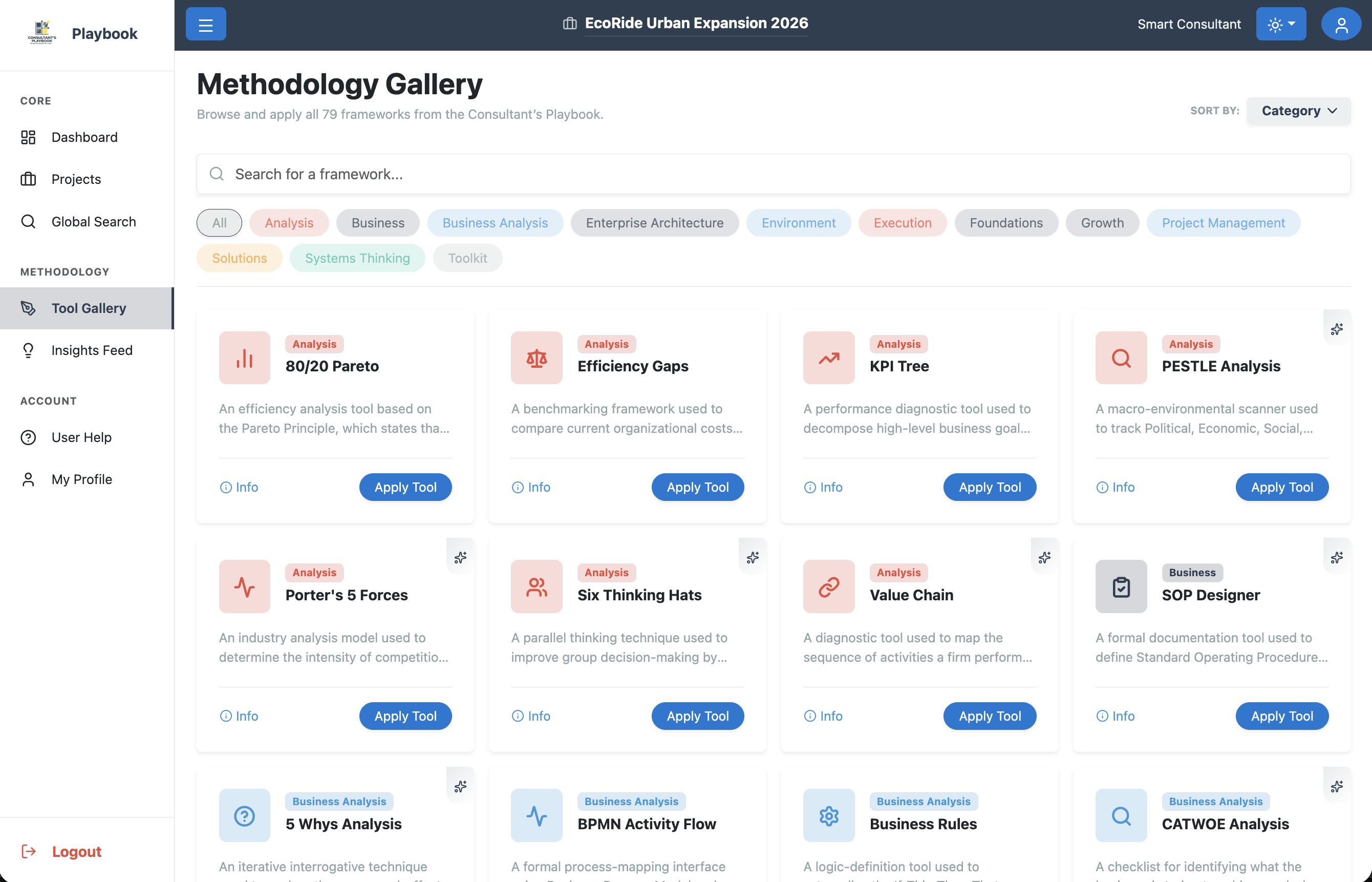
A classic 2x2 strategic planning framework used to identify internal Strengths and Weaknesses alongside external Opportunities and Threats. It helps firms align their internal capabilities with the competitive landscape.
PESTLE Analysis
A macro-environmental scanner used to track Political, Economic, Social, Technological, Legal, and Environmental factors. It identifies broad market shifts that could impact long-term corporate strategy.
Porter's 5 Forces
An industry analysis model used to determine the intensity of competition and market attractiveness. It evaluates the bargaining power of buyers/suppliers and the threat of new entrants or substitutes.
TAM/SAM/SOM
A market estimation framework used to calculate the Total Addressable Market (TAM), Serviceable Addressable Market (SAM), and Serviceable Obtainable Market (SOM). Essential for realistic growth planning.
Value Chain
A diagnostic tool used to map the sequence of activities a firm performs to deliver a valuable product or service. Use it to identify specific links where costs can be cut or differentiation can be added.
OODA Framework
A high-velocity decision-making cycle (Observe, Orient, Decide, Act) designed for competitive environments. It enables organisations to react to market changes and out-maneuver competitors through faster iteration.
SOP Designer
A formal documentation tool used to define Standard Operating Procedures. It captures process headers, owners, and sequential steps, automatically generating a Mermaid flowchart to visualise the operational path.
Marketing Plan
A comprehensive 6x6 strategy matrix for planning market entry and growth. It aligns target segments with the marketing mix (Product, Price, Place, Promotion) and execution logic.
SOC 2 Checklist
A structured roadmap for achieving and maintaining SOC 2 compliance. It covers the four-phase process from preparation to ongoing maintenance, ensuring all Trust Services Criteria (TSC) are met and documented for audit.
SOC 1 ICFR Checklist
A comprehensive roadmap for Internal Controls over Financial Reporting (ICFR). It tracks preparation steps, control implementation, and auditor engagement to ensure accuracy and integrity of financial data.
Meeting Notes
A structured meeting record capturing participants, general insights, key outcomes, and split action items for both the consulting team and the client. Mirrors a professional meeting notes template.
KPI Tree
A performance diagnostic tool used to decompose high-level business goals (like Revenue or ROI) into their underlying mathematical drivers. It enables consultants to identify the exact lever responsible for performance variance.
80/20 Pareto
An efficiency analysis tool based on the Pareto Principle, which states that 80% of outcomes result from 20% of causes. Use it to ruthlessly prioritise high-impact efforts and eliminate low-value activities.
Efficiency Gaps
A benchmarking framework used to compare current organisational costs against industry standards or best-in-class competitors. It highlights specific areas of waste and quantifies the potential for margin improvement.
Capability Map
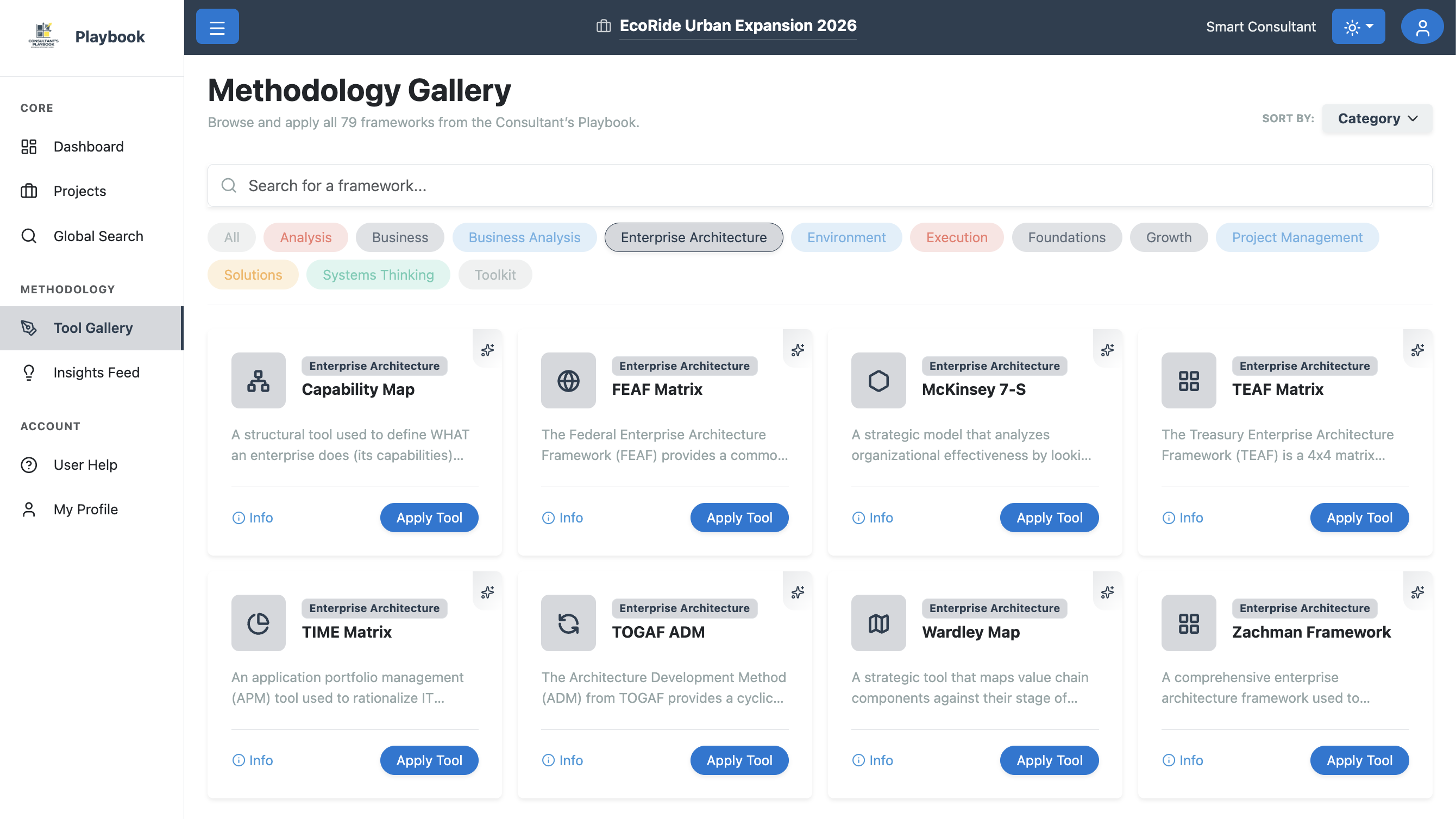
A structural tool used to define WHAT an enterprise does (its capabilities) rather than HOW it does it. It provides a stable, business-centric view of the organisation that serves as a heatmap for identifying strategic maturity and technical debt.
TIME Matrix
An application portfolio management (APM) tool used to rationalise IT systems based on Business Value and Technical Quality. Categorises systems into: Tolerate (low value/high quality), Invest (high value/high quality), Migrate (high value/low quality), or Eliminate (low value/low quality).
Wardley Map
A strategic tool that maps value chain components against their stage of evolution (Genesis, Custom, Product, Commodity). It helps identify where to build, buy, or outsource, and where disruption is likely to occur.
Systems Thinking
A holistic diagnostic approach used to identify non-linear feedback loops and causal relationships within a business. It helps avoid "whack-a-mole" problem solving by addressing root causes rather than symptoms.
Zachman Framework
A comprehensive enterprise architecture framework used to organise and analyse a business from six distinct perspectives (What, How, Where, Who, When, Why) across six levels of abstraction (from Executive to Enterprise).
TEAF Matrix
The Treasury Enterprise Architecture Framework (TEAF) is a 4x4 matrix used to organise and analyse an enterprise architecture through four Views (Functional, Information, Organisational, Infrastructure) and four Perspectives (Planner, Owner, Designer, Builder).
TOGAF ADM
The Architecture Development Method (ADM) from TOGAF provides a cyclic process for developing an enterprise architecture. Use this tool to track status and key deliverables across the 8 phases (A to H).
FEAF Matrix
The Federal Enterprise Architecture Framework (FEAF) provides a common methodology for IT acquisition, use, and disposal across the US Federal Government. It focuses on the Consolidated Reference Model (CRM).
McKinsey 7-S
A strategic model that analyses organisational effectiveness by looking at seven internal elements: Strategy, Structure, Systems, Shared Values, Style, Staff, and Skills. Use it to ensure architectural changes align with organisational reality.
Process Mapping
A visualisation technique used to document "As-Is" workflows and design "To-Be" optimised states. It reveals bottlenecks, redundant loops, and handoff errors that decrease operational velocity.
SIPOC Diagram
A high-level process overview (Suppliers, Inputs, Process, Outputs, Customers) used to define the boundaries of an engagement. Essential for ensuring all stakeholders understand the scope of a transformation.
Service Blueprint
An operational tool that maps the frontstage customer experience directly to the backstage organisational processes. It ensures that service delivery is seamlessly supported by internal systems and staff actions.
Impact Mapping
A strategic planning technique that prevents organisations from getting lost in features and deliverables by explicitly connecting every task to a specific actor, an intended impact, and a high-level goal.
Data Flow (DFD)
A technical diagram used to visualise how information moves through a system. It identifies data sources, processes, storage points, and destinations, helping to pinpoint integration gaps or security risks.
Morphological Box
A creative problem-solving tool used to generate diverse strategy bundles. By breaking a solution into independent parameters and listing alternatives for each, it enables the discovery of unique, non-obvious configurations.
Decision Frameworks
A combination of the BCG Matrix (Market Share vs. Growth) and the Ansoff Matrix (Product vs. Market). These tools provide a structured way to decide whether to harvest, divest, or invest in specific business units.
ICE Prioritisation
A rapid scoring framework used to prioritise initiatives based on their Impact, Confidence, and Ease of implementation. It removes subjectivity from roadmap planning and ensures the highest-value tasks are tackled first.
Kano Model
A product prioritisation framework used to categorise customer requirements into Must-be, Performance, and Delighter attributes. It helps BAs identify which features will truly drive customer satisfaction.
MoSCoW Prioritise
A requirement management technique used to reach stakeholder agreement on delivery priority. It categorises items into Must-have, Should-have, Could-have, and Won't-have (for now).
Fishbone Diagram
A root cause analysis tool (also known as Ishikawa) used to brainstorm and categorise the potential causes of a specific problem across the 6Ms: Methods, Machines, Materials, Manpower, Measurement, and Mother Nature.
5 Whys Analysis
An iterative interrogative technique used to explore the cause-and-effect relationships underlying a particular problem. By repeating the question "Why?", the primary root cause can be identified and addressed.
Six Thinking Hats
A parallel thinking technique used to improve group decision-making by looking at a problem from six distinct perspectives: Facts, Emotions, Risks, Benefits, Creativity, and Process.
User Story Mapper
A product discovery tool used to visualise the user journey and organise the backlog into a coherent narrative. It helps teams plan releases that deliver a complete "slice" of value to the customer.
User Personas
A tool used to create fictional, yet data-driven, representations of your ideal users. It helps BAs and designers understand user goals, pain points, and behaviours to ensure the solution meets real needs.
User Journey Map
A visual representation of the process a user goes through to achieve a goal. It maps out the stages, touchpoints, and emotions, helping to identify friction points and opportunities for improvement.
CATWOE Analysis
A checklist for identifying what the business is trying to achieve and what the problem areas are. It looks at Customers, Actors, Transformation, Worldview, Owner, and Environmental constraints.
MOST Analysis
An internal strategic analysis tool used to ensure that a project is aligned with the organisational Mission, Objectives, Strategies, and Tactics.
Risk Assessment
A proactive management tool used to plot project risks based on their Likelihood and Impact. It enables teams to develop mitigation and contingency plans for the most critical threats before they occur.
MVP Testing
A lean methodology framework used to define and test strategic assumptions. It forces teams to build the "minimum viable test" to validate a business hypothesis before committing significant capital.
Business Model
A comprehensive organisational design tool (the Business Model Canvas) used to map how a firm creates, delivers, and captures value. It identifies the critical relationships between partners, activities, resources, and customer segments.
Strategic Roadmap
A multi-horizon planning tool used to visualise the evolution of a business over time. It balances short-term operational improvements (Horizon 1) with medium-term growth scaling (Horizon 2) and long-term future innovation (Horizon 3).
Value Pricing
A strategic pricing framework used to shift from cost-plus or hourly models to value-based capture. It helps consultants and firms align their fees with the actual economic impact or "willingness to pay" of the client.
Lean Canvas
An adapted business model framework specifically designed for startups and new product initiatives. It focuses on the problem-solution fit, unique value proposition, and customer segments, enabling rapid iteration and validation.
Scaling Limits
A diagnostic model used to identify the "complexity tax" that occurs as an organisation grows. It highlights internal friction points and system constraints that must be automated or refactored to maintain growth velocity.
Change Mgmnt
A structural framework based on Kotter's principles for managing organisational transformation. It focuses on creating urgency, building a guiding coalition, and generating short-term wins to ensure long-term cultural adoption.
Action Plans
A tactical execution tool used to convert high-level strategy into specific, accountable tasks. It ensures every initiative has a clear owner, a firm deadline, and a measurable "Definition of Done" to prevent project drift.
Kanban/Gantt
A hybrid project management interface that supports both daily flow (Kanban) and long-term dependency tracking (Gantt). It provides visibility into work-in-progress and helps teams manage resource constraints effectively.
Dependency Map
A risk-mitigation diagram used to identify critical paths and task interdependencies. By mapping how one deliverable impacts another, it helps project managers anticipate and bypass potential bottlenecks.
Burn-up/down
An agile progress-tracking tool used to visualise the relationship between time, scope, and work completed. It provides an empirical forecast of when a project or sprint is likely to be finished based on historical velocity.
4Ls Retrospective
A team continuous-improvement framework used at the end of a project phase. It categorises feedback into what was Liked, Learned, Lacked, and Longed For, turning project experiences into organisational knowledge.
Risk Register
A formal audit log used to track every identified risk throughout the project lifecycle. It includes detailed descriptions of probability, impact, and specific owners assigned to each mitigation strategy.
Power/Interest
An alignment grid used to categorise stakeholders based on their influence over the project and their interest in its outcome. Essential for developing tailored communication and engagement strategies.
KPIs vs OKRs
A metrics-alignment framework that distinguishes between "The Engine" (Key Performance Indicators) and "The Destination" (Objectives and Key Results). Use it to balance business-as-usual with growth initiatives.
RACI Matrix
A responsibility assignment matrix used to clarify roles for project tasks. It defines who is Responsible, Accountable, Consulted, and Informed, eliminating ambiguity and overlapping authority.
Comm. Grid
A strategic communication planning tool used to define the frequency, channel, and message for each stakeholder group. It ensures that the right information reaches the right people at the right time.
SMEAC - Five Paragraph Order
A structured military briefing format (Situation, Mission, Execution, Administration & Logistics, Command & Signal) adapted for consulting engagements. It ensures every stakeholder understands the context, objective, plan, resources, and chain of command.
Continuous Impr.
A data-driven improvement cycle (Define, Measure, Analyse, Improve, Control) derived from Six Sigma. It provides a rigorous methodology for identifying and eliminating defects in organisational processes.
Force Field Analysis
A change-management tool used to identify the driving forces for change and the restraining forces against it. By strengthening the former and weakening the latter, it helps ensure successful implementation.
Meeting Checklists
A set of operational readiness checks used to ensure every stakeholder meeting is productive. It covers data preparation, decision-maker attendance, and agenda alignment to prevent "meetings that could have been emails."
Project Notes
A flexible, Markdown-supported scratchpad used to capture raw observations, interview transcripts, and meeting minutes. It serves as the "unstructured" repository for project knowledge before it is synthesised into formal tools.
Mindmap
A visual brainstorming tool powered by Mermaid.js that helps consultants map out hierarchical ideas and complex relationships. Ideal for the early discovery phases when the problem space is still being explored.
Slide Library
A repository of pre-formatted strategic layouts and 2x2 matrices. It enables consultants to jumpstart their client deliveries by providing proven visual structures for complex data representation.
Case Archive
A knowledge-management tool used to archive completed projects and their outcomes. It enables the firm to perform pattern-matching across different engagements and apply "what worked before" to new challenges.
Sample Walkthrough
An educational resource that guides users through the "Messy Middle" of a realistic consulting project. It demonstrates how to apply multiple tools in sequence to reach a high-quality strategic synthesis.
Use Case Spec
A detailed requirements tool used to document specific user-system interactions. It defines actors, preconditions, post-conditions, and the step-by-step "happy path" and alternative flows for a business process.
Context Diagram
A high-level scoping diagram that identifies the boundaries of a system. It maps the external entities (people, departments, or other systems) that interact with the project scope and the data flows between them.
NFR Catalog
A technical requirements repository used to define Non-Functional Requirements (NFRs) such as performance, security, availability, and scalability. These ensure that the "How" of the system is as robust as the "What."
BPMN Activity Flow
A formal process-mapping interface using Business Process Model and Notation (BPMN) standards. It provides a technical and standardised way to communicate workflows across business and IT stakeholders.
Business Rules
A logic-definition tool used to externalize the If-This-Then-That constraints of a business. By separating decision logic from the process flow, it ensures that organisational policies are easy to audit and update.
Decision Table
A matrix-based tool used to map complex combinations of conditions to specific business actions. It ensures that every logical scenario is accounted for, preventing errors in automated or manual decision-making.
Data Dictionary
A technical repository used to define every data field used in a project. It specifies data types, sizes, allowed values, and validation rules, ensuring consistency across databases and user interfaces.
Entity Relation (ERD)
A database design tool used to visualise the conceptual structure of project data. It maps entities and their relationships (1:1, 1:N, N:N), providing a blueprint for physical database implementation.
State Chart
A behaviour modeling tool used to visualise the lifecycle of a business object. It maps the different states an entity can be in and the events that trigger transitions between them.
Interface Catalog
An integration management tool used to document the connections between different technical systems. It tracks the source, destination, format, and frequency of every data exchange in the architecture.
RTM Matrix
A Requirements Traceability Matrix (RTM) used to ensure that every high-level project goal is addressed by a specific requirement and implemented in a final task. It prevents project scope creep and ensures delivery completeness.
Can't find what you're looking for?
We're constantly adding new frameworks to the Playbook. Suggest a tool or get started today.